Just How Hplc Is Used To Check Peptide Purity
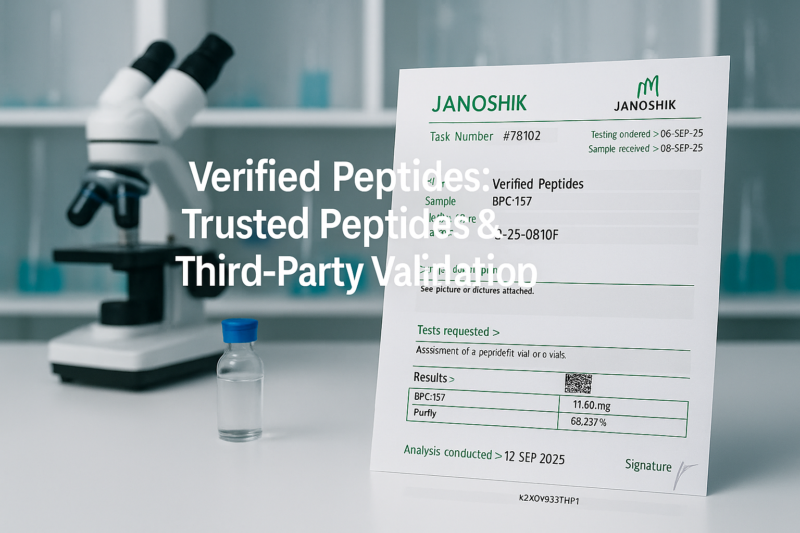
Why Hplc Purity Screening Issues For Research Study Peptides 2026 All peptides sold by Peak Research laboratory are designated solely for in-vitro laboratory study use and are not for human intake. Peptide screening paperwork should be interpreted as batch-level analytical proof for research material, not as clinical-use permission. HPLC can support claims about chromatographic pureness, pollutant optimal concern, and degradation trends when the approach is suitable and the chromatogram is readily available. When a brand-new peptide batch includes a Certificate of Analysis, scientists guarantee there is a solitary predominant height in the HPLC result and a high purity percentage. If the peptide is, say, 98% pure by HPLC, they proceed with self-confidence; if the HPLC reveals multiple big contamination tops or purity below ~ 90-- 95%, they may deny or additional detoxify that batch. The retention time of the main height is additionally compared to assumptions or previous sets as an extra identity check. By using just HPLC-verified peptides, researchers reduce the risk of confounding variables in their assays. For instance, a peptide at 90% purity versus one at 99% purity can create divergent biological results. Microbiological standing of tidy room controlled settings are assessed by monitoring the culture of microorganisms in the laboratory workspace. The location under the main peptide peak, contrasted to the complete location of all peaks, identifies the pureness percent. Research-grade peptides typically reveal a dominant peak representing 99% or more of the total area, with very little contamination heights. Accurate logical validation is important to confirm peptide identity, pureness, and security. Our solutions include HPLC and mass spectrometry screening to guarantee that peptides fulfill research-grade requirements. By validating molecular structure and pureness, we help researchers preserve reproducibility and adhere to regulative criteria. Our analytical solutions provide self-confidence in every peptide set, reducing speculative risk and sustaining both preclinical and clinical applications where accuracy is vital for success. It is taken into consideration the gold-standard method for evaluating how much of a sample is the wanted peptide versus contaminations [2] For instance, a peptide at 95% purity still consists of ~ 5% spin-offs that could interrupt delicate experiments if undetected [2] By utilizing HPLC to make certain a peptide is, say, 98-- 99% pure, scientists greatly lower the threat of such confounding variables. High-performance fluid chromatography is the technique that can divide, recognize, and evaluate elements in a combination. HPLC testing is the most effective chromatography technique necessary to most labs across the globe. HPCL assay is likewise used in method advancement, method validation, and research study testing. Knowing just how to check peptides for purity guarantees the integrity and reproducibility of every research study protocol. This overview discusses the three gold-standard logical techniques-- HPLC, mass spectrometry, and third-party screening-- and exactly how researchers can interpret results to validate that their substances satisfy research-grade top quality criteria. Without orthogonal techniques to identify these microheterogeneities, they multiply in a system (death as 'organic variability'), lowering signal-to-noise and inevitably revoking entire information collections. Official HPLC/MS characterization freezes that https://writerhavenx.com/s/VyhYsb2VyzJVGhnceaRyV entropy in place, subjecting each molecule to two orthogonal choice pressures (hydrophobicity and mass-to-charge), developing an analytical firewall program around false identity. Normal purity degrees vary in between 99.0% and 99.7%, aligning with worldwide lab research requirements. These tests validate that peptides from Peptides Lab UK include no contaminants, destruction by-products, or unwanted fillers-- just verified, high-purity research material. We additionally pair the HPLC results with mass spectrometry confirmation of the peptide's molecular weight to fully verify that the series is proper [4] Each item's Certification of Analysis supplies the HPLC purity outcome and the MS information, giving full openness. This approach makes sure that scientists can have full confidence in the pureness and identification of the peptides they get [4] When examining a synthetic peptide, labs generally utilize reversed-phase HPLC evaluation with UV discovery. Techniques use either UV/Vis or Fluorescence detectors, ideal for your healthy protein or little particle. In addition, NEBA has substantial facilities and years of expertise in qualitative and measurable separations utilizing HPLC mass spectrometry detection of peptide medications. Solid, semisolid, and fluid formulas of pharmaceutical leads are one crucial action in drug growth. Techniques are enhanced to verify the API concentration in your application formulation, as well as service uniformity and security. In addition, if stereoisomers are part of the formulation, we have years of chiral experience at your solution. Peptide screening is the logical process made use of to confirm that a study peptide is both pure and appropriately determined.
When Is Hplc Approach Advancement, Validation, And Hplc Analysis Made Use Of?
- Our solutions consist of HPLC and mass spectrometry testing to guarantee that peptides meet research-grade demands.
- HPCL assay is also made use of in technique advancement, approach recognition, and study testing.
- With that being said, developing peptides can be difficult due to the fact that they break down conveniently and are unbelievably conscious ecological conditions.
- Purity is calculated by dividing the major optimal area by the total incorporated area of all UV-absorbing peaks.
Why Purity Matters In Research
Just how much does peptide HPLC testing expense?
The expense of peptide evaluation solution differs substantially based on which methods your regulative package calls for: HPLC-UV Evaluation: $& #x 24; 300 & #x 2013; & #x 24; 800 per example (standard pureness assessment) LC-MS (Liquid Chromatography-Mass Spectrometry): $& #x 24; 600 & #x 2013; & #x 24; 1,500 per example (molecular weight confirmation).